
A Ruaha National Park safari puts you in the middle of Tanzania‘s largest national park, a wild slab of the southern circuit built around the Great Ruaha River and famous for oversized lion prides, big elephant herds and rarely watched predators like wild dog. Most visitors fly in from Dar es Salaam or Iringa and base themselves at a small camp for game drives, walking safaris and night drives. Ruaha sits in south-central Tanzania, spans roughly 20,226 square kilometres of baobab country and miombo woodland, and stays quiet even in peak season.
What follows is a plain, practical guide to what a Ruaha safari actually looks like on the ground: the wildlife you have a real chance of seeing, the drives and walks on offer, when to come, where to sleep and how to get there. Ruaha rewards people who want space and big game without the vehicle crowds of the north, and it works best when you give it a few unhurried days rather than a rushed overnight stop.
Planning a longer trip? Explore our Tanzania safari holidays to see how Nyerere fits into a full itinerary.
What a Ruaha National Park Safari Is Really Like
The first thing to understand about a Ruaha safari is scale. This is Tanzania’s biggest park by area, and it forms the core of a far larger protected system, the Rungwa-Kizigo-Muhesi ecosystem, which stretches across roughly 45,000 square kilometres when you count the neighbouring reserves and the wildlife management area. That size shows up in the driving. You cover ground, you go long stretches without seeing another vehicle, and sightings feel earned rather than handed to you.
The park sits at a natural crossroads. Ruaha is where southern and eastern African species overlap, so the plant and animal mix is broader than you get in a single-zone park. Miombo woodland dominates the western hills, while acacia and combretum bush spread across the east, and the whole place is studded with baobabs, some of them well over a thousand years old. The Great Ruaha River runs along the south-eastern edge and pulls wildlife toward it, especially as the dry months bite and the smaller water sources fade.
Give Ruaha at least three nights. One day is barely enough to reach the productive river circuits, and the park’s size means the best game viewing often comes on your second or third morning once your guide has read where the herds and prides are moving.
Because it sits on the southern circuit, Ruaha pairs naturally with Nyerere National Park rather than with the Serengeti and Ngorongoro up north. Many people combine the two southern parks into one trip, flying between them on light aircraft. The mood down here is different: fewer people, more walking, and guiding that leans on tracks, alarm calls and detail rather than radio chatter between crowded vehicles.
Big Cat Safaris and Ruaha’s Giant Lion Prides
Lions are the headline act on almost any Ruaha safari, and the numbers back it up. The wider Ruaha area is thought to hold more than ten percent of the world’s remaining lions, one of the most important strongholds left on the continent. Prides here run large. Groups of twenty or more are seen fairly regularly, which is unusual and makes for a different kind of sighting than the small family units you often find elsewhere.
Ruaha’s lions have a reputation for tackling big prey, buffalo included, and there are well-documented cases of prides taking on young elephants, behaviour that is rare across the rest of Africa. You watch that dynamic play out best in the dry season, when lions hold ground near the river and the remaining waterholes and simply wait for thirsty animals to come to them. Sightings are never guaranteed, but the odds on a dry-season morning drive are genuinely good.
Leopard and cheetah round out the big cats. Leopard turn up along the rocky kopjes and the wooded river margins, often at dawn or after dark, while cheetah favour the more open plains in the east of the park. Both are less predictable than lion, so treat a clear leopard sighting as a bonus rather than a certainty. The work of the Ruaha Carnivore Project, running since 2009, has helped track these cats and cut the human-carnivore conflict that once made this one of the worst places in East Africa for lion killings.
Elephant and Buffalo Game Drive Safaris Along the Great Ruaha River
Big herds are the other reason people book a Ruaha game drive safari. The park protects one of Tanzania’s largest elephant populations, and something in the order of 12,000 elephant move through the greater Ruaha region across the year. During the dry months they concentrate near water, so a slow drive along the Great Ruaha River and its sand tributaries will usually put you within sight of family groups digging in the riverbed for water.
Buffalo gather in the same corridors, sometimes in herds several hundred strong, and where buffalo mass, lions tend to follow. That overlap along the river is where a lot of the park’s drama happens. Your guide will often work the same stretches morning and afternoon, reading fresh tracks and dung to judge which herds are close and where the predators sit in relation to them.
Morning game drives. Cool starts are best for predators still active from the night. Lion, cheetah and the occasional wild dog are most likely in the first two or three hours after first light, along with any nocturnal stragglers heading to cover.
Afternoon and sundowner drives. Later drives suit grazing herds. Elephant, buffalo, giraffe, zebra and the antelopes come out to feed as the heat drops, and you can end with a drink parked above the river as the light goes.
Full-day drives with a picnic. Ruaha’s size makes a full day worthwhile. Packing lunch lets you reach the quieter far circuits and stay out through the middle of the day, when a shaded riverbank can still turn up drinking herds.
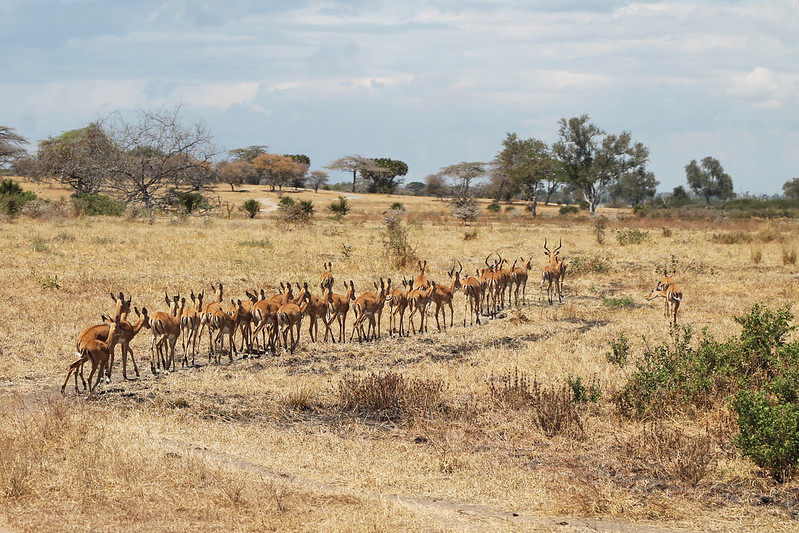
Away from the giants, general plains game fills out the drives. Giraffe, zebra, impala, waterbuck, warthog, eland and hippo are all common, and the birdlife along the water keeps the slow moments busy. This is honest big-game country, and the driving does most of the work.
Wild Dog and Predator Tracking Safaris
Ruaha is one of the few places in Africa where wild dog are watched with any regularity, and for many guides they are the park’s true flagship rather than the lions. African wild dog are endangered and range over huge territories, so seeing them is always partly down to luck, but Ruaha’s healthy population gives you a real shot that most parks cannot offer.
A predator tracking safari here means patience and early starts. Wild dog hunt at first light and again in the cooler late afternoon, moving fast and covering distance, so your guide works from fresh tracks, denning reports in the June to August pup season, and alarm calls from impala and baboon. When a pack is found near a den, you can sit with them for a long, rewarding stretch as the adults come and go.
Spotted hyena, jackal, bat-eared fox and smaller carnivores like serval and genet fill out the predator list, most of them easier to see on a night drive than during the day. The point of Ruaha is not a checklist of guaranteed sightings but a wild country rich enough in carnivores that something interesting is usually happening if you put in the hours.
Few parks in Africa let you reasonably hope for lion, leopard, cheetah and wild dog in the same few days. Ruaha is one of them, provided you come in the dry season and give it time.
Kudu, Sable and Roan Antelope Watching on Safari
Serious wildlife watchers come to Ruaha for its antelopes as much as its cats. The park sits at that meeting point of southern and eastern species, so you get an unusual line-up on a single antelope watching safari. Both greater and lesser kudu live here, and Ruaha holds the largest greater kudu population in East Africa, with the big spiral-horned bulls most visible in the drier months around the rocky hills.
Rarer still are sable and roan antelope, two striking species you simply do not find together in most Tanzanian parks. Sable, dark and scimitar-horned, tend to favour the miombo in the west, while roan range across the more open woodland. Neither is a given on a short visit, so ask your guide early if they are a priority and build a drive or two around the areas where they are being seen.
The everyday antelope cast is generous too, with impala, waterbuck, Grant’s gazelle, bushbuck, eland and the odd oribi all in the mix. For anyone who cares about seeing a proper range of species rather than only the famous few, Ruaha delivers a longer list than most single parks manage.
Walking Safaris Among Ruaha’s Baobabs and Miombo
A walking safari is where Ruaha shows a quieter side. On foot with an armed ranger and a guide, you drop out of the vehicle’s rhythm and start noticing the small things: tracks pressed into a sand river, the way a dung beetle works, birds you would never register from a moving car, the smell of crushed leaves. You may also meet big animals at close range, which is part of why the ranger sets the pace and the rules.
The best walking comes late in the dry season, roughly September and October, when the bush has thinned and the going is easier. Ruaha is widely rated among the finest walking-safari parks in Africa during these months. Guides use the walks to read the baobab country and the miombo up close, explaining how the two vegetation zones meet and how animals use each.
Walking safaris are not about ticking off big game. Come to them for the detail and the pace, wear muted colours and closed shoes, and keep your voice down. Anything large you do see on foot lands far harder than the same animal from a vehicle.
Not every camp offers walking, and some park sectors allow it more freely than others, so check when you book if a walk matters to you. Where it is on the menu, a morning on foot pairs well with drives and gives your trip a change of gear.
Night Game Drive Safaris for Nocturnal Wildlife
A night game drive safari opens up a whole shift of animals that daytime drives miss. Once the sun drops, a guide works a spotlight across the bush to pick out the nocturnal hunters: leopard on the move, plus serval, genet, civet and the wide eyes of bushbabies up in the branches. Honey badger, mongoose, bat-eared fox and nightjars all turn up on the good nights.
Night drives run from lodges that hold the right permits and usually head out just before or after dinner. Beyond the wildlife, the sky is a genuine draw. Ruaha sits far from any town glow, so on a clear, moonless night the stars are about as good as they get on a Tanzanian safari. Cool, dry evenings in the middle of the year make for comfortable driving.
As with every activity here, nothing is promised. A quiet night might turn up little more than a scrub hare and a genet, while a good one lands a hunting leopard. That unpredictability is the honest reality of night driving, and it is worth doing at least once for the animals you cannot see any other way.
Birdwatching Safaris in Ruaha National Park
With more than 570 recorded species, Ruaha is strong ground for a birdwatching safari, whether you are a committed lister or just enjoy colour between the big-game moments. Hornbills, bee-eaters, rollers, kingfishers and a long line-up of raptors are all easy to find, and the river margins concentrate waterbirds through the dry season.
The park sits at that southern-and-eastern crossroads for birds as much as mammals, so the mix keeps things interesting for anyone who already knows the northern parks. The wet months, roughly November to April, bring the migrants and the best of the breeding plumage, and the rare Eleonora’s falcon passes through around December and January. Green-season birding is a real reason to consider the low months, even if the big game is harder to spot then.
Best Time for a Ruaha Safari
Timing shapes a Ruaha trip more than almost anything else. The dry season, June to October, is the standout window for game viewing. As the bush thins and the small waterholes dry up, animals crowd toward the Great Ruaha River, and lion, elephant and buffalo become far easier to find. September and October are the driest and the peak for both concentrated game and walking safaris, though they are also the hottest.
June to August, dry and building. The park greens up early in June after the long rains, then dries steadily. Water sources shrink, herds gather, and July into August brings excellent, reliable game viewing with pleasant, cooler days.
September to October, peak dry. The driest, warmest stretch and the best odds for concentrated big game and the finest walking conditions of the year. Book camps well ahead, as this is the busiest window.
November to April, green season. Short and long rains bring dramatic skies, newborn animals and the migrant birds. Grass grows tall and some tracks turn tricky, so game is harder to spot, but the park is quiet and prices ease.
If your main aim is big cats, elephant and wild dog, aim squarely at July to October. If you care most about birds, baby animals and low-season quiet, the green months have their own case, as long as you accept that thicker bush makes the marquee sightings less certain.
Safari Camps and Lodges in Ruaha
Accommodation in Ruaha runs small and low-key, which suits the park. Most options are intimate tented camps rather than big lodges, and staying inside the park saves you long transfers and puts you into the game at first light. A handful of names anchor the choice for a Ruaha safari.
Jabali Ridge. A polished lodge in the north, set on a rocky kopje with wide views over baobab country toward the Mwagusi river. Eight suites plus a private house, an infinity pool and a spa make it the upper-end pick, well placed for the productive northern circuits.
Jongomero. One of the most remote camps in the country, alone in the south of the park with eight large tented suites on raised decks above a dry riverbed. Quiet, smart and far from anywhere, with a pool, it suits people who want true isolation.
Kwihala Camp. A smaller, classic tented camp on a northern hillside, long valued for strong guiding and an unfussy bush feel. Check its current status when you plan, as availability has shifted, and ask your operator for the latest before you count on it.
Beyond these, other camps and a public bandas option near the park headquarters at Msembe cover a range of budgets, and some travellers base themselves cheaper around Iringa or Tungamalenga village just outside the park. Where you sleep affects which sectors you reach easily, so match the camp to the wildlife you most want to see and ask which activities, walking and night drives included, each place actually runs.
Getting to Ruaha National Park for Your Safari
Reaching Ruaha is part of committing to the southern circuit, and there are two honest ways in. Flying is the simplest. Scheduled light aircraft run most days from Dar es Salaam, with connections from Arusha, Dodoma and the other southern parks, landing at Msembe airstrip inside the park or at Jongomero in the south. The Dar flight takes roughly two to two and a half hours and drops you straight into the game, which is why most international visitors choose it.
Handpicked Nyerere safari packages
Driving is the budget route and a longer haul. The park lies about 130 kilometres west of Iringa town, on a road that is passable year round, while the run from Dar es Salaam to Iringa is a long day on tarmac before you turn off. Reckon on around ten hours of driving from Dar overall, and expect rough, dusty going near the park. A 4×4 is needed to move around the tracks inside Ruaha in any season.
Most people fly in and out, or fly one way and combine Ruaha with Nyerere National Park by air to save the long road transfers. Whichever way you come, build in a little slack, as light-aircraft schedules and road conditions both shift with the season.
Ruaha Safari FAQ
How much does a Ruaha National Park safari cost?
The park charges non-residents a daily entry fee of about 30 US dollars per adult and 10 dollars for children aged five to fifteen, with lower rates for residents. On top of that, camps inside the park pass on a concession fee of roughly 35 dollars per person per night, and an 18 percent VAT applies to park fees. Once you add flights, a camp and guided activities, a typical fly-in Ruaha safari runs from the low hundreds of dollars per person per night at simpler camps to well over a thousand at the premium lodges. Budget travellers driving in and using public bandas or camping can bring the daily cost down a lot.
What are the park entry and activity fees?
Non-resident park entry sits around 30 dollars per adult per day and 10 dollars per child, before the 18 percent VAT. A guided night game drive costs in the region of 59 dollars per person, and public campsite fees are usually around 15 dollars per person per night. Concession fees for staying at camps inside the park add roughly 35 dollars per person per night. Rates change from time to time, so confirm the current figures with your operator before you travel.
How many days do you need for a Ruaha safari?
Three nights is a sensible minimum. The park is large and sightings often build over successive drives, so a single night rarely does it justice. Three to four nights lets you mix morning and afternoon game drives with a walking safari and a night drive, and gives your guide time to work out where the lions, elephant and any wild dog are moving. Keen wildlife watchers happily spend a week.
When is the best time to visit Ruaha for wildlife?
The dry season from June to October is best for game viewing, when animals crowd toward the Great Ruaha River and the bush is thin enough to see through. September and October are the driest and the strongest for concentrated big game and walking safaris, though also the hottest. The green season from November to April is quieter and excellent for birds and newborn animals, but taller grass makes the big cats and wild dog harder to find.
What wildlife can you expect to see in Ruaha?
Lion are the near-certainty in the dry season, often in unusually large prides, along with big elephant herds and buffalo near the river. Ruaha is also one of the better places in Africa for wild dog, and it holds the largest greater kudu population in East Africa plus rarer sable and roan antelope. Leopard, cheetah, hyena, giraffe, zebra, hippo and more than 570 bird species round out the list. As always on safari, nothing is guaranteed, and the rarer predators reward patience.
Can you do walking and night safaris in Ruaha?
Yes. Ruaha is one of Tanzania’s best parks for walking safaris, led by an armed ranger and usually at their finest in September and October when the bush has thinned. Night game drives run from camps that hold the right permits and are the way to see nocturnal animals like leopard, genet, civet and bushbabies. Not every camp offers both, so check that your chosen place runs the activities you want before you book.