
A boat safari in Nyerere National Park runs roughly two to three hours along the Rufiji River and its lakes, in a canopied motorboat, past hippo pods, basking crocodiles and birds working the sandbanks. Camps run morning and sunset departures, with longer trips reaching the lake system. Nyerere sits in southern Tanzania and is the largest national park in Africa.
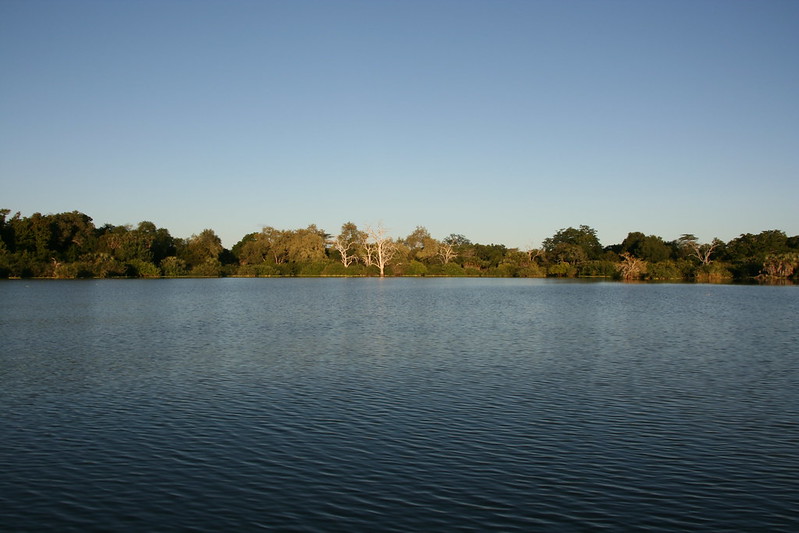
Almost nobody arrives in the south for the game drives alone. They come because this is one of the few places in Tanzania where you can spend a morning on the water and still be looking at big game, close, at eye level, with the engine cut. That is what makes the Rufiji River boat safari the thing this park is known for, and the reason a southern circuit trip feels nothing like a week in the north.
Rufiji River Boat Safari: What the Trip Actually Involves
A Rufiji boat safari starts at a jetty or a sandy bank near your camp, usually a short drive or a walk from your tent. Boats are small. Most carry between six and twelve guests on bench seating under a fabric canopy, with an outboard engine at the stern and a guide who doubles as the driver. Life jackets come out before you push off. So does a cooler box.
Then the engine drops to a mutter and you drift. That is the whole method, really. Your guide reads the water, noses the boat into a channel, cuts the motor, and lets the current carry you toward whatever is on the bank. Because animals along the Rufiji are used to boats and not to people on foot, the tolerance distance is short. You get closer on the water than you ever would in a vehicle, and you do it without the diesel rattle that announces a game drive from half a kilometre away.
Expect a mix of open river and narrow side channels. The Rufiji braids constantly, splitting around sandbars and doubling back through palm fringed cuts barely wider than the boat. Your guide picks the route on the day based on depth, wind and what has been reported that morning. Some trips barely leave a single lagoon because the game is thick there. Others cover several kilometres of river.
Sit on the shaded side and bring a cloth for your lens. Spray off the bow and fine river dust are the two things that ruin photographs on a Nyerere boat safari, and neither is obvious until you are already out on the water. A wide brimmed hat that ties on beats a cap, because the boat picks up speed on the return leg.
Morning, Sunset and Full Day Boat Safari Options in Nyerere
Camps mostly offer the same three shapes of boat safari, and they are genuinely different trips rather than the same outing at different clock times.
The morning departure leaves after early coffee, often around six thirty, and runs until mid morning. Light is soft and low, birds are active, and hippos are still returning to the water after a night of grazing on land. This is the better slot for photography and for birding. It is also the cooler one, which matters more than people expect in a park where midday heat regularly climbs past thirty five degrees.
Afternoon and sunset trips push off around four and come back in the dark blue light after the sun drops behind the palms. Crocodiles are the draw here, since they have spent the day soaking up heat and lie out on the sandbanks in numbers. Warmth also brings elephants down to drink. Plenty of camps carry gin, tonic and a bucket of ice on the sunset run and cut the engine mid river for a sundowner while the sky goes orange behind Stiegler’s Gorge country.
Full day boating trips are the serious option, and not every camp offers one. These pair the Rufiji itself with the lake chain, break for a picnic lunch under a fig or a doum palm, and give you a shot at the species that never come down to the busier stretches of river. A few operations run a houseboat lunch instead, moored on a lake, with the small boats ferrying guests out and back.
Morning boat safari. Roughly two hours from around six thirty. Best light, best birding, active hippos, cooler air. The standard first activity on a two night stay.
Sunset boat safari. Roughly two to three hours from around four. Crocodiles out on the sand, elephants coming to drink, a sundowner stop mid river before the run home in the dark.
Full day boat and lake safari. River plus the lake system with a picnic lunch. Reaches Nzerakera and the Rufiji channels beyond the camp circuit. Offered by a handful of camps, worth requesting when you book.
Boat and walk combination. The boat drops you on a bank for a guided walking safari, then collects you further downstream. One of the better half day formats in the park, subject to guide availability and water level.
The Lake System a Nyerere Boat Safari Reaches: Tagalala, Manze, Nzerakera and Siwandu
The Rufiji does not simply run through Nyerere. It sprawls. Below the gorge the river spills into a chain of five large lakes, listed from east to west as Lake Tagalala, Lake Manze, Lake Nzerakera, Lake Siwandu and Lake Mzizimia, all linked by channels that fill and shrink with the season. Boat safaris work this whole system, not just the main river, and which water you end up on depends almost entirely on where you sleep.
Lake Tagalala is the classic boating lake, big, open and heavy with crocodiles. Hot springs sit near its shore, which is a separate excursion rather than part of the boat trip, though several camps combine the two in a morning. Tagalala holds water reliably late into the dry months, so the concentrations here build as everything else thins out.
Lake Manze is smaller, shallower and ringed with dead trees that make good perches for fish eagles and cormorants. The boating from the camp on its shore is done on the lake itself or in a neighbouring channel, and it is the sort of water where you spend an hour covering four hundred metres because there is something to look at every time you lift your binoculars.
Lake Nzerakera and Lake Siwandu sit further along the chain, reached by boat up the Rufiji and through the maze of tributaries. Camps on this stretch run canopied motorboats out into the channels, and because the water is quieter you can go a full trip without meeting another boat.
None of these lakes behaves the same way twice in a year. Channels that carry a boat easily in July can be sandbar by late October, and the guides adjust the route without much fuss.
Hippos and Crocodiles on a Rufiji River Boat Safari
Hippo and crocodile are the two species you can be reasonably confident of on any boat safari in Nyerere National Park, and the park carries very large populations of both. Pods of twenty or thirty hippo are ordinary on the wider bends. They will grunt, submerge, resurface twenty metres off the bow and give you the long flat stare that guides read constantly for mood.
Good boat guides keep their distance and hold a line the pod can move away from, because a hippo that feels cornered between a boat and the bank is the one real hazard on this trip. If your guide suddenly reverses out of a channel without explaining, that is why. Trust it.
Crocodiles here run large. The Rufiji supports some of the biggest Nile crocodiles in East Africa, and on a warm afternoon you will see them stacked along the sand with their mouths open, which is temperature control rather than threat. Sightings are not guaranteed on any single trip, though crocodile and hippo are as close to dependable as wildlife gets in the dry months, when the water pulls everything in.
The engine goes quiet and you hear the river instead: hippos breathing, a fish eagle two bends away, the small collapse of a bank giving way. That silence is what a boat safari buys you.
Elephants and Riverbank Game Viewing on a Nyerere Boat Safari
Beyond the water species, the banks themselves are the second act. Giraffe, impala, waterbuck, greater kudu, warthog and baboon come down to drink through the day, and from a boat you watch them without the animal ever registering you as a threat. Blue monkeys and black and white colobus work the riverine forest, and Nile monitor lizards drop off logs as you pass.
Elephants are the sighting everyone hopes for. Herds cross the Rufiji in the dry season, and a family swimming across a channel with only trunks and foreheads showing is the image that sells this park. It happens often enough to be worth hoping for and not often enough to promise. Ask your guide honestly what has been crossing that week, and take the answer at face value.
Wild dog also use the river margins, and Nyerere holds one of the largest remaining populations in Africa. Seeing them from the boat is uncommon. Seeing them at all on a three night stay is a decent possibility, mostly on game drives, mostly around denning season in the middle of the year.
Birding Boat Safaris on the Rufiji: Fish Eagles, Skimmers and Kingfishers
If one activity in southern Tanzania justifies packing proper binoculars, it is this one. A birding boat safari on the Rufiji puts you level with species that are difficult to work from a vehicle, and the boat can hold position while you sort out a plumage detail.
African fish eagles are everywhere along the river and call constantly, which is the sound most people remember from the trip. Sandbanks host breeding African skimmers, a bird with a lower mandible longer than the upper that it drags through the surface to feed, and the Rufiji is one of the more reliable places in the region for them. Goliath herons stalk the shallows. Malachite and pied kingfishers sit on reed stems within a few metres of the boat. Boehm’s bee eaters cluster on overhanging branches in the late afternoon.
The palm and riverine margins also hold Pel’s fishing owl, a heavy rufous owl that some birders chase for years without success. Guides on this river know the roost trees. Sightings still take luck and an early start.
Numbers climb from November through March when migrants arrive, though the boating itself is easier and the light better in the dry months. Birders often accept the tradeoff and come in the green season anyway.
Why the Nyerere Boat Safari Sets This Park Apart from the Northern Circuit
Serengeti, Ngorongoro and Tarangire are excellent parks and none of them can offer this. The northern circuit is built around the vehicle: you sit in a Land Cruiser, you find animals on open plains, and on a busy morning in the Seronera you share a leopard with fourteen other cars. Nyerere is a water park with woodland around it, and the activity mix reflects that.
Nyerere National Park. Game drives plus boat safaris on the Rufiji and its lakes plus guided walking safaris and fly camping. Very low vehicle density, with full days in the field where you see nobody else. Strong for hippo, crocodile, elephant, wild dog, buffalo and riverine birds. Reached by a flight of about an hour from Dar es Salaam.
Northern circuit parks. Game drives are the main activity, with balloon flights in the Serengeti and walking restricted to specific areas. Higher vehicle numbers at good sightings in peak months. Strong for big cats, plains game and the migration. Reached via Arusha and Kilimanjaro.
The two circuits are complements rather than rivals. Many well built Tanzania trips run the north for cats and the migration, then fly south for a few nights of boating and walking so the holiday does not become five straight days of the same view through a roof hatch.
Best Season for a Rufiji Boat Safari and How Water Levels Change the Trip
The dry months from June to October are the standard answer, and for boating they hold up. Rain stops, seasonal pans dry, and animals that spent the green season scattered across thirty thousand square kilometres of miombo funnel back toward permanent water. Your two hour boat trip is passing through the busiest strip of habitat in the park.
Water level does the rest of the work. Too high and the game spreads out while channels run fast and muddy. Too low and sandbars start blocking routes, which is a real consideration in October when guides sometimes shorten the run or switch lakes. The sweet spot for most camps falls somewhere across July, August and September, when the river has dropped enough to concentrate wildlife but still carries a boat comfortably.
June to July. Rain has finished, greenery still on the banks, water levels good and falling. Comfortable temperatures. Boating is straightforward across the whole lake system.
August to September. Peak dry conditions and the strongest concentrations along the river. Hot by midday. Book early because camps fill and boat slots are limited by the number of craft.
October to November. Very hot, water at its lowest, some channels closing to boats. Sightings can be outstanding right at the water. Short rains often start in November.
December to May. Green season. Birding peaks, the park empties of visitors, rates drop. Heavy rain in March through May closes some camps entirely and boating is possible but murkier, with wildlife dispersed inland.
Which Nyerere Camps Run Boat Safaris on the Rufiji and Its Lakes
Boating is not universal in this park, so check it before you book. Camps sit inside the park along the river and the lakes, and each runs boats on the water directly in front of it.
Siwandu occupies a private peninsula on Lake Nzerakera and runs canopied motorboats into the lake, the Rufiji and the surrounding channels, with a houseboat used for lake lunches. Lake Manze Camp boats on Manze itself and a neighbouring channel, with trips of roughly two hours in the morning or afternoon, and it has a long reputation for value. Roho ya Selous sits in the lake belt and combines boating with drives and walks. Impala Camp on the Rufiji is another solid value option with good guiding, and Rufiji River Camp holds a well known river frontage near Mtemere.
Lodges outside the park boundary along the river also run boat trips, though a boat excursion inside the park boundary is charged alongside conservation fees, so the arithmetic differs from a camp based inside. Two nights is the minimum for a boat safari to be worth the travel. Three lets you take a morning boat, a sunset boat and still have time for a walk and a proper game drive.
Getting to Nyerere National Park for Your Boat Safari
Handpicked Nyerere safari packages
Flying is how most people arrive. Light aircraft leave Julius Nyerere International in Dar es Salaam for the park airstrips, and the hop takes about an hour, with several carriers running daily morning and afternoon services. Camps meet the plane, and it is entirely normal to land at eleven and be on the water by four.
Driving works too and saves money. Dar es Salaam to Mtemere Gate is roughly two hundred and thirty kilometres through Kibiti and Mloka, about five hours, with the last stretch on rough gravel. Matambwe Gate in the north, reached via Morogoro, Mkuyuni and Kisaki, takes closer to six or seven hours. Neither drive is glamorous. Both are doable in a decent vehicle outside the heavy rains.
Nyerere Boat Safari Questions Travellers Ask
How much does a boat safari in Nyerere National Park cost?
Boat trips are usually quoted between about 25 and 40 US dollars per person when charged as a park activity, though many camps sell them as part of a package where you will see figures closer to 50 to 200 US dollars per person depending on group size, trip length and whether lunch or drinks are included. Guests staying at camps inside the park often find one or two boat trips already built into a full board rate, so ask what is included before you pay for anything separately.
What are the park entry fees for Nyerere National Park?
Published non resident entry sits at around 50 US dollars per adult for each twenty four hour period and about 20 US dollars for children under fifteen, with residents paying less. Sources differ, and some quote higher figures once value added tax and other charges are added, so treat roughly 50 to 82 US dollars as the working range per adult per day. Concession fees for staying in park accommodation run near 80 US dollars, and vehicle entry adds around 47 US dollars. Fees are set by Tanzania National Parks and are payable in advance through their online system, so confirm the current rate with your operator rather than relying on a figure you read anywhere.
How long does a Rufiji River boat safari last?
Standard trips run about two hours, sometimes stretching to three if the game is good and the guide is happy to linger. Full day boating outings that take in the lakes and a picnic lunch run five to seven hours. Some camps also do a shorter one hour sundowner cruise for guests arriving late in the day.
Is a morning or a sunset boat safari better?
Morning for birds, soft light and cooler air. Sunset for crocodiles out on the sandbanks, elephants coming down to drink and the sundowner stop. If you are staying two nights or more, do one of each. They genuinely feel like different activities on the same river.
Are boat safaris in Nyerere safe with all those hippos and crocodiles?
Yes, with a competent operator. Boats carry life jackets, guides keep a working distance from hippo pods and never wedge a boat between a pod and the bank, and the craft used are stable and suited to the water. The rules are simple: stay seated, keep hands and arms inside, and do not ask the guide to move closer than they are comfortable with. Follow those and it is a low risk activity.
Can children go on a boat safari in Nyerere?
Most camps set a minimum age for boating, commonly somewhere between six and twelve years, and a few reserve the right to decide on the day. Family rules vary a lot between properties, so if you are travelling with young children, confirm the boating age limit in writing at the time of booking rather than assuming.
What should I wear and bring on a Rufiji boat safari?
Neutral colours, long sleeves for sun and insects, a hat that ties on, sunglasses and high factor sunscreen. Binoculars make a large difference here. Bring a light fleece for the sunset trip because the run home across open water gets cool once the sun is down, and pack cameras in something that seals, since spray comes over the bow when the boat picks up speed.