
A Nyerere budget safari runs on three swaps: drive from Dar es Salaam rather than fly, sleep at a simple camp near Mtemere gate rather than inside the park, and share a vehicle with other travellers. Most operators sell it as a three day group departure booked out of Dar es Salaam. Nyerere National Park in southern Tanzania is the former Selous Game Reserve, a Rufiji River wilderness known for boat safaris and wild dogs.
That is the short version. The longer one is more interesting, because the gap between a cheap Nyerere safari and an expensive one is not really a gap in wildlife. Same river. Same elephants. Same guides, quite often, since the good freelance guides work across every tier. What changes is comfort, flexibility, and how much of the day you spend in a vehicle instead of a hammock.
You can build this visit into one of our Tanzania safari holidays for a seamless journey.
What a Nyerere Budget Safari Actually Includes
Before comparing options it helps to know what the standard budget safari package covers, because the phrase gets used loosely and the exclusions are where people get caught out.
Nearly every budget tour to Nyerere bundles the same core: road transport in a 4×4 or a tour van, an English speaking driver guide, full board accommodation, drinking water, two game drives a day, and park entry fees. Some operators quote park fees separately. Read that line carefully. Park fees are the single biggest fixed cost in a Nyerere safari and a quote that excludes them is not really a quote.
What sits outside the price is fairly consistent: international flights, Tanzanian visa, tips for the guide and cook, alcohol and soft drinks, and any activity beyond the game drives. Boat safaris on the Rufiji are sometimes included and sometimes not. Walking safaris almost never are, since they carry a separate ranger charge.
Ask one question before you book: “Is the park entrance fee included, and for how many days?” A three day safari can mean two park days or three, and the difference lands entirely on you if the answer is vague.
Group size is written into the price too. Budget operators quote per person on a sliding scale, so a couple pays noticeably more each than a party of six covering the same vehicle and the same guide. That single fact drives most of the money saving strategies further down this page.
Road Transfer Safaris from Dar es Salaam Instead of Flying In
Skipping the plane is the biggest saving available on a Nyerere safari, and it is the swap most first time visitors are nervous about. The light aircraft hop from Dar es Salaam to Mtemere airstrip takes about forty five minutes. The road takes five to seven hours to cover roughly 230 kilometres through Kibiti and Mloka, and the last stretch is rough enough that operators build in buffer time.
So you lose the better part of a day in each direction. In return you cut a cost that, on a short trip, can rival the entire rest of the budget. Coastal Aviation, Auric Air and Safari Air Link all serve the route, and their fares are per person each way, which means a couple flying in and out pays four fares while a couple driving pays for one vehicle.
The drive itself is not wasted time. You pass through coastal villages, rice paddies and cashew country, and the run from Kibiti onward strips away the last of the traffic. Guides tend to stop at Mloka for a cold drink before the gate. Plenty of travellers finish that drive and say they would do it again, mainly because it gives the park a sense of distance that a plane erases.
Road transfer safari
Five to seven hours from Dar es Salaam via Kibiti and Mloka. Cost is per vehicle, so it splits across the group. Arrival is late morning or early afternoon, which usually means you still get an afternoon game drive on day one. Best for groups of three or more, and for anyone spending three days or longer in the park.
Fly in safari
Around forty five minutes to Mtemere or Siwandu airstrip. Cost is per person each way. Frees up two half days of your trip and skips the rough road entirely. Worth it for solo travellers on very short trips, for anyone short on holiday time, and during the wet months when road sections can slow to a crawl.
There is a third option that almost nobody mentions. The TAZARA railway runs west out of Dar es Salaam and passes along the northern edge of the Nyerere ecosystem, with basic seating or a compartment berth for a fraction of any road or air transfer. It is slow, the timetable is a suggestion rather than a promise, and you will still need a pickup at the other end. For independent travellers with spare days it is a genuine option rather than a novelty.
Budget Camps Near Mtemere Gate for a Nyerere Safari
The reason a Nyerere budget safari works at all is geography. A cluster of simple camps sits just outside the eastern boundary around Mloka village, minutes from Mtemere gate, on the same stretch of the Rufiji that the expensive camps look out over. You sleep outside the park and drive in each morning.
Selous Mbega Camp is the best known of them. It sits in its own patch of riverine forest on the Rufiji near Mtemere, with canvas tents on platforms, private bathrooms, and verandas facing the water. Rates are quoted full board, and the camp has long run a lower rate for guests who arrive at Mloka by public bus rather than by private vehicle, which tells you something about the crowd it serves.
Selous River Camp, also at Mloka, works on tiers. The cheapest rooms are simple bandas and tents in the woodland with shared washing facilities, and the rates climb from there to river facing cottages. Booking the lowest tier and spending the saving on an extra park day is a trade most repeat visitors make.
Other options come and go around the village, including small guesthouses used by drivers and NGO staff, and a handful of newer camps that appear on booking sites at low rates. Standards vary. Read recent reviews rather than the camp’s own photographs, since one or two of the older properties have gone through long stretches of deferred maintenance.
The hidden benefit of sleeping outside the park: camps beyond the boundary pay no concession fee to the park authority, which is a per person nightly charge that lodges inside must collect from guests. It is baked into the room rate at every camp inside the gate, and simply absent outside it.
The cost of staying out is the early start. Gates open at first light, so a Mloka based safari means breakfast in the dark and a short transfer before the drive begins. Camps inside the park have wildlife wandering past at breakfast. Yours might have hippos grunting in the river, which is not a bad substitute.
Camping Safaris Inside Nyerere National Park
A camping safari is the other route to a low cost trip, and it is a very different experience from a fixed camp. You sleep in dome tents at a public campsite inside the park, your operator brings a cook and all the equipment, and meals are prepared over a fire or a gas ring.
Public campsites in Nyerere are basic. A long drop or a simple ablution block, a water point that may or may not be running, and no fence. Nothing dramatic usually happens, though hyenas do come through camps at night looking for scraps and hippos graze near the river after dark, which is why guides ask you to stay in your tent once the fire is out.
The saving is real, since you are paying a camping fee rather than a room rate. The catch is that camping fees inside the park are charged per person per night on top of your park entry, so the gap between camping and a cheap camp outside the gate is narrower than people expect. Where camping wins outright is on longer trips and in larger groups, because the equipment and cook costs are shared across everyone.
One thing worth knowing about really cheap camping tours: you may be asked to pitch in. Setting up tents, breaking camp, washing up after dinner. Some travellers love that. Others discover on night two that they had pictured something else entirely. Ask the operator directly whether the crew handles everything or whether guests help.
Group Joining Safaris and Shared Departures to Nyerere
If there is one lever that moves the price of a Nyerere National Park safari more than any other, it is how many people are sitting in the vehicle. Park fees are per person, so those do not budge. Almost everything else divides.
A driver guide costs the same whether he carries two guests or six. So does the vehicle, the fuel across the same route, the cook on a camping trip, and the transfer from Dar es Salaam. Operators reflect this openly in their pricing, and the drop from a party of two to a party of six is usually somewhere near a quarter off the per person rate.
Two people booking a private vehicle are paying for four empty seats. Filling them is the cheapest upgrade in Tanzanian safari planning.
Group joining departures exist for exactly this reason. Operators running weekly scheduled trips from Dar es Salaam and Zanzibar pool solo travellers and couples into one vehicle at a fixed per person rate. You give up control of the itinerary and you cannot ask the driver to sit at a leopard sighting for an hour if the rest of the vehicle is hungry. What you get back is a private trip price divided by six.
Finding one takes a little work. Scheduled departures are advertised on operator sites and safari marketplaces, and dates cluster around weekends and the dry months. Hostels and backpacker lodges in Dar es Salaam and Stone Town are the old fashioned way, and still the most effective. Post on the noticeboard, ask at reception, and you will often find two other people looking for the same thing.
Keeping Park Fees Down on a Nyerere Safari
Park fees are the floor under every Nyerere safari, budget or otherwise, and they are non negotiable. What is negotiable is how many of them you pay, and that comes down to the way the ticket clock runs.
Entry is valid for 24 hours from the moment you pass the gate. Not a calendar day. Twenty four hours. Overstay by even a short margin and you owe a fresh day at the full rate, which is the most common way budget travellers accidentally blow a carefully planned budget.
The practical result shapes the whole trip. Enter mid morning and you should exit before mid morning on the following day, which is why so many operators schedule the long boat safari for the afternoon of arrival and a final game drive on the way out. Staying outside the park at Mloka gives you real control here, since your accommodation is not tied to the clock and you decide when to cross the boundary.
A few other things reduce the total. Children under a set age pay a reduced rate and the youngest go free, so families should check the bands rather than assume a flat per head charge. Residents and East African citizens pay a fraction of the visitor rate, and anyone holding a Tanzanian work permit should carry it, since the gate applies the visitor rate to anybody who cannot prove otherwise. Fees also shift between peak and low season in some parks, which feeds directly into the timing question below.
Budget Safari Versus Mid Range Safari in Nyerere: What You Give Up
Honest comparison matters more than cheerleading here, because a budget safari is a set of trade offs and they are not all trivial.
Vehicle and seating
Budget trips often use a tour van with a pop top roof rather than an open sided Land Cruiser. Vans handle the main tracks fine in the dry months and struggle in mud. Mid range trips put you in a 4×4 with a window seat guaranteed, which matters more than it sounds when you are photographing across two rows of people.
Time in the park
Staying at Mloka costs you roughly forty minutes each way. Over a three day safari that adds up to a couple of hours of prime early light spent driving to and from the gate rather than looking for animals. Camps inside the park start the drive from the doorstep.
Activity range
Mid range packages usually fold a Rufiji boat safari into the price and sometimes a walking safari with an armed ranger. Budget packages tend to include game drives only, with the boat and the walk sold as extras on the day.
Comfort and food
Expect simple rooms, intermittent power from a generator or solar, cold water at some hours, and cooking that leans on rice, stew and fruit. It is decent and filling. It is not a lodge kitchen, and nobody pretends otherwise.
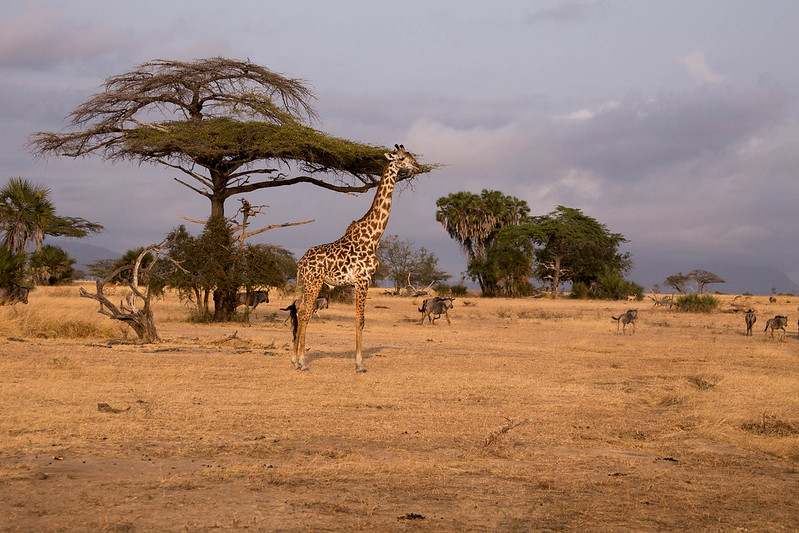
What you do not give up is the wildlife. Nyerere holds one of the largest wild dog populations left in Africa, along with elephant, buffalo, giraffe, greater kudu, sable antelope and lion across the Rufiji floodplain. Sightings are never guaranteed at any price. The animals do not check your booking class, and a budget vehicle parked at the same lagoon as a luxury one is looking at the same hippos.
The one thing money genuinely buys in Nyerere is exclusivity in the remoter western sectors, which budget operators rarely reach. Most cheap trips work the eastern zone around Mtemere and Lake Tagalala, and that is where the concentration of game is anyway during the dry months.
Best Value Season for a Nyerere Budget Safari
Timing shifts the cost of a Nyerere National Park safari more than any accommodation choice, and the cheapest window is not the worst window.
June to October, the dry season
Peak game viewing and peak prices. Water sources shrink to the Rufiji and the lakes, drawing animals into the open, and the bush thins out so you can actually see through it. Camps are full, group departures run often, and finding people to share a vehicle with is easiest. Book well ahead.
Late October to December, the short rains
Brief afternoon storms, green regrowth, and softer pricing before the Christmas period pushes rates back up. Game viewing stays reasonable since the ground has not yet become saturated. A good compromise window for anyone who wants dry season conditions without dry season crowds.
January to March, the hot spell
Hot and humid with scattered rain. Migrant birds arrive in numbers and the Rufiji birding is at its best, which suits anyone whose interest runs beyond big mammals. Rates sit below peak and the park is quiet.
April to mid June, the long rains
The cheapest stretch of the year outside the Easter period. Many seasonal tented camps close entirely, the larger lodges stay open and discount hard, and some throw in free nights. Tracks turn to mud, the grass grows tall, and spotting game takes patience and a good guide.
For value rather than pure cheapness, the sweet spot most operators point to is early June and again the second half of October, when rates have not yet climbed to peak or have just come off it, while the bush is still open enough for good viewing. April and May are for travellers who genuinely do not mind working harder for sightings and who are happy with a lodge rather than a canvas camp.
Boat Safaris and Walking Safaris on a Budget Trip
The Rufiji boat safari is the thing that separates a Nyerere safari from any other park in Tanzania, and it would be a strange economy to skip it. Two hours drifting past hippo pods, crocodiles hauled out on sandbanks, and fish eagles working the channels, at eye level rather than from a vehicle. Prices are quoted per person and drop sharply as the boat fills, so it is another place where travelling with a group pays.
Book it through the camp rather than through your tour operator if it was not included, since the camps at Mloka run their own boats and their walk up rate is usually lower than the package price. Late afternoon is the run to take, when the light softens and the birds come to the water.
Walking safaris carry two charges, one for the activity and one for the armed ranger who must accompany every group. Split across four or five people the ranger fee becomes small. Walking is the cheapest way to buy an entirely different kind of morning: tracks, dung, termite mounds, the small stuff that a vehicle drives straight past.
Fishing on the Rufiji, village walks at Mloka, and night drives in the buffer zone round out the extras. None of them are expensive on their own, and stacking two or three onto a budget trip still lands well below a mid range package that includes them.
Getting to Nyerere National Park for Your Budget Safari
Most budget trips start in Dar es Salaam, which has the international airport, the bus stands, and nearly all the operators running scheduled departures. From there the road runs south through Kibiti, turns inland at Ikwiriri, and reaches Mloka before Mtemere gate.
Public buses cover the Dar to Kibiti and Mloka legs for very little, leaving early from Mbagala and Temeke. It is a long, crowded ride and it drops you at the village rather than the gate, so you need a camp that will collect you. Selous Mbega has run that arrangement for years. This is the true shoestring route into Nyerere and it works, provided you are flexible about time.
Handpicked Nyerere safari packages
Coming from Zanzibar, the ferry to Dar es Salaam plus a road transfer the next morning is the standard budget chain, and several operators sell the whole thing as one package. Flying Zanzibar to Mtemere direct exists but undoes the saving in one step.
Self driving is possible for anyone comfortable with rough tracks and river crossings, though the park requires a high clearance 4×4 and recovery gear, and fuel between Ikwiriri and the gate is unreliable. For most visitors a shared vehicle with a guide who knows where the wild dogs denned last week is both cheaper and better.
Frequently Asked Questions About a Nyerere Budget Safari
How much does a budget safari in Nyerere National Park cost?
Budget safaris to Nyerere typically run from around 250 to 400 US dollars per person per day, with the very cheapest camping trips landing near 260 dollars a day. A standard three day, two night package from Dar es Salaam is commonly quoted from about 750 dollars per person for a party of two, dropping to roughly 615 to 654 dollars per person once the group reaches four to six people. Those figures usually cover transport, guiding, full board accommodation, water and park fees. Always confirm the park fee line before you pay a deposit.
What are the park entry fees for Nyerere National Park?
Non resident adults pay around 50 US dollars per 24 hours, with some sources citing up to 70 dollars during peak months, and children aged five to fifteen pay roughly 20 to 30 dollars. Under fives enter free. East African citizens and Tanzanian residents pay far less on production of a national ID or a passport showing a work permit or residence visa. Gates accept US dollars, Tanzanian shillings, and Visa or Mastercard. Guests sleeping inside the park also pay a concession fee per night, which is one reason the camps outside the boundary come in cheaper.
How much do budget camps near Mtemere gate charge?
Selous Mbega Camp near Mloka quotes around 100 US dollars per person full board, with a reduced rate near 70 dollars for guests who arrive by public bus. Selous River Camp starts near 80 dollars per person full board for its simplest woodland rooms with shared bathrooms, rising to about 118 dollars and above for river facing accommodation. Rates soften in the long rains from April, when several seasonal camps close and the remaining properties discount to fill beds.
Is it cheaper to drive or fly to Nyerere on a budget safari?
Driving is cheaper for almost everyone. A private 4×4 transfer from Dar es Salaam runs roughly 150 to 300 US dollars for the vehicle one way, split across the whole group, while flights to Mtemere airstrip start near 205 to 221 dollars per person each way. For two people the road saves a few hundred dollars and for a family it saves considerably more. The TAZARA train is cheaper still, with economy seats near 10 dollars and first class compartments near 20, though it costs you a day and needs a pickup at the other end.
How much extra are boat safaris and walking safaris in Nyerere?
A Rufiji boat safari costs roughly 25 to 30 US dollars per person for an hour on the water in a group of five or six, with some camps quoting from about 24 dollars up to 40 depending on the boat and the duration. Walking safaris are charged at around 24 dollars per person plus a similar figure for the compulsory armed ranger, so splitting the ranger fee across a group makes the walk noticeably cheaper per head. Booking either directly with your camp at Mloka is usually cheaper than adding it through an operator.
What is the cheapest time of year for a Nyerere safari?
April to mid June, excluding the Easter period, is the cheapest window of the year. Accommodation rates fall sharply, some lodges add free nights, and the park is close to empty. The trade is wet tracks, tall grass and harder game viewing, plus the closure of many seasonal tented camps. If you want a balance of price and sightings, early June or the second half of October gives you dry season conditions at rates below the July to October peak.
Can you do a Nyerere safari as a solo traveller on a budget?
Yes, and the route is a scheduled group departure rather than a private trip. Operators in Dar es Salaam and Zanzibar run weekly joining safaris that pool solo travellers into one vehicle at a fixed per person rate, which avoids the single supplement effect of paying for a whole 4×4 yourself. Backpacker lodges in Dar es Salaam and Stone Town are still the best places to find other travellers heading the same way in the same week.