
Crocodiles in Nyerere National Park are seen most reliably on a Rufiji River boat safari, where big Nile crocodiles lie hauled out on exposed sandbanks and drift in the shallows within a few metres of the boat. Sightings run common through the dry months, though never quite guaranteed, and the odds along this river are among the best anywhere in Africa. Nyerere National Park is a 30,893 square kilometre reserve in southern Tanzania, cut from the northern Selous and built around the Rufiji.
If crocodiles are the reason you are looking at this park, you have picked well. The Rufiji River and its chain of lakes hold one of the densest populations of Nile crocodiles on the continent, and the park was designed so that most visitors get onto the water rather than only driving past it. What follows is a plain look at where these animals are, how they behave, and how to plan a safari around watching them safely.
Crocodile Sightings on a Rufiji River Boat Safari
The Rufiji River boat safari is the single best way to see crocodiles here, and it is the activity that sets Nyerere apart from the northern parks where boats are not allowed. A typical trip lasts one to two hours, tracking the main channel and slipping into quieter side arms where the water goes still. Crocodiles turn up almost from the moment you push off. They sprawl on the sandbanks in loose groups, jaws propped open, and slide into the river as the boat drifts closer.
Because you approach from the water rather than a vehicle, the angle is low and close. Guides cut the engine and let the current carry you, so you watch a two or three metre crocodile at eye level with nothing between you and the bank but a few boat lengths of brown river. Bigger animals, the old males that have held a stretch of shoreline for years, tend to stay put longer and let the boat pass. Afternoon runs often show the most activity, since the rising heat pulls crocodiles down toward the cooler water.
Sit on the shaded side of the boat and keep your camera ready before you round each bend. The best crocodile views come fast, usually as the boat clears a sandbar and a dozen animals scatter off the bank at once. Ask your guide to hold position downstream so the light falls across the river rather than into your lens.
Meeting the Nile Crocodiles of the Rufiji on Safari
The animal you watch on a Nyerere safari is the Nile crocodile, Africa’s largest reptile and one of the largest crocodilians in the world. Adults commonly run around five metres and several hundred kilograms. The record for an accurately measured male, shot near Mwanza in Tanzania, reached 6.45 metres and weighed over a tonne, so the truly giant individuals are Tanzanian in origin. Most crocodiles you see on the Rufiji sit well below that, in the two to four metre range, with the odd heavyweight basking apart from the rest.
These are old survivors of a very old lineage, built as ambush hunters. A crocodile floats with only eyes, ears and nostrils breaking the surface, looking for all the world like a waterlogged log, then holds motionless until prey comes within reach. On the Rufiji you will often spot that log shape first and only realise it is a crocodile when it blinks or eases forward. The Selous ecosystem, which Nyerere now covers, holds the largest crocodile population in Tanzania, and survey work on the lower Rufiji has counted well over seven crocodiles per kilometre of river in places.
Watch a stretch of river long enough on the Rufiji and the sandbanks stop looking empty. What seemed like driftwood turns out to be a line of crocodiles, each holding its own patch of sun.
Crocodile Behaviour Watching on the Sandbanks
Much of what you see on a crocodile watching safari is the animal doing nothing, and that stillness is the point. Crocodiles are cold blooded, so they spend hours hauled out on the sandbanks warming up in the sun. You will notice many lying with their mouths wide open. That gaping is not aggression. It is how a crocodile sheds heat once its body warms, a bit like a dog panting, letting the moist lining of the mouth cool it down while the back keeps soaking up sun.
Through the day they shuttle between land and water to hold their body temperature steady, easing off the bank into the shallows when the heat climbs, then hauling back out to bask. On the Rufiji sandbanks this plays out in slow motion, groups of crocodiles shifting position by inches over an hour. The exposed banks also matter for breeding. Females dig nests in the sand above the waterline and guard them, which is why the wide dry season sandbars are so busy with animals.
Crocodile Feeding and Hunting on a River Safari
The Nile crocodile is an opportunist that will take almost anything it can catch. Along the Rufiji the everyday diet is fish. The river runs thick with tigerfish, catfish, tilapia and Nile perch, and that steady food supply is part of why the crocodile density here is so high. Fish carry the bulk of the load, so the dramatic land kills people picture are the exception rather than the rule.
That said, a big crocodile is a serious predator. Across its range the Nile crocodile takes antelope, zebra, warthog, young hippos, buffalo and, at the water’s edge, animals as large as wildebeest during a river crossing. The classic technique is to wait at a drinking spot, explode from the shallows, and drag the prey under. On a river safari you are unlikely to witness a kill, since these are rare and quick, but guides read the signs well and can position the boat where the drinking herds and the waiting crocodiles overlap. Set your expectations toward watching behaviour rather than banking on a hunt.
Boat safari on the Rufiji. The main crocodile activity. Low water level, close approach, and the widest sandbanks make the dry months the strongest window for reliable sightings from the river.
Lake cruise on Tagalala or Manze. Quieter water and dense concentrations of crocodiles and hippos gathered around shrinking lagoons as the dry season sets in.
Walking safari near the shoreline. A guided approach on foot to the water margin, where an armed ranger keeps a safe buffer and you read tracks, nests and slide marks in the mud.
Lake Tagalala and the Lagoons for Crocodile Sightings
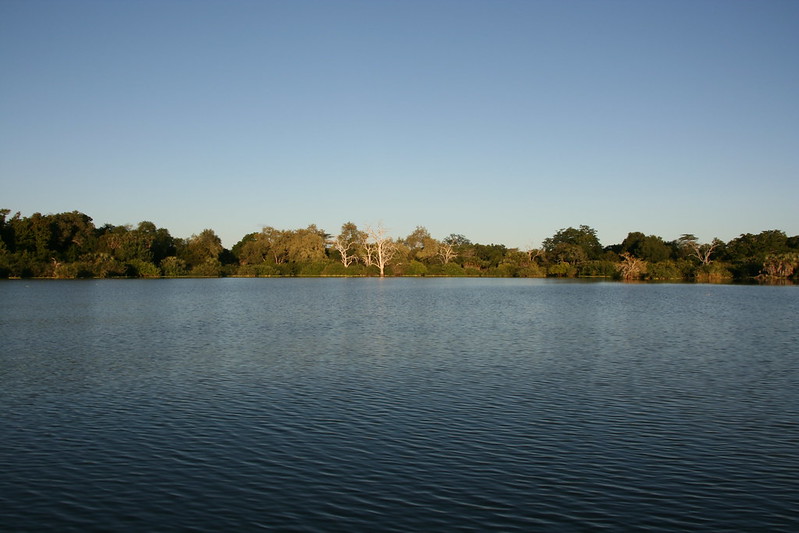
The Rufiji does not just run as a single river. It branches into a set of lakes and lagoons, the main ones being Lake Tagalala, Lake Manze, Lake Nzerakera, Lake Siwandu and Lake Mzizimia, strung out across the northern part of the park. These lakes are fed and drained by the river, and as the dry season bites they shrink, packing crocodiles, hippos and thirsty game tighter and tighter around the remaining water.
A boat cruise on Lake Tagalala is one of the calmer ways to watch crocodiles, since the water is flatter than the main channel and the animals gather in numbers along the fringing palms. Near Tagalala you also find the Beho Beho hot springs, where sulphurous water runs off the hills into warm pools, a stop some walking safaris fold in. Each lake fringe carries its own crocodiles, so guides often pick a lagoon by which one is holding the most game that week rather than following a fixed route.
Crocodiles and Hippos Watching Together on Safari
You almost never watch crocodiles here without watching hippos too, and the way the two share the water is one of the quiet pleasures of a Rufiji safari. Nyerere holds one of the biggest hippo concentrations of any park in Africa, and the pods jam the pools and channels alongside the crocodiles. The relationship is mostly one of wary tolerance. Hippos are territorial and will shove crocodiles off a favoured basking spot, and a crocodile tends to give a bull hippo room.
Crocodiles do sometimes take hippo calves, yet even large crocodiles rarely push the issue, because a mother hippo and the surrounding pod defend the young hard enough to make it a bad bet. So what you see from the boat is a kind of standoff that mostly holds. Crocodiles and hippos lie within a few metres of each other on the same sandbank, each keeping half an eye on the other, neither willing to start a fight it might not finish.
Best Time for a Crocodile Boat Safari in Nyerere
The dry season, roughly June to October, is the best time for a crocodile boat safari in Nyerere. As the rains stop, the river drops, the sandbanks widen, and the lakes contract, so crocodiles haul out in bigger numbers and the water pulls in game from across the park. Late June is a sweet spot, dry enough for strong sightings but ahead of the peak season prices. July through October holds the most reliable conditions and the clearest, lowest water.
The wet months, from around November to April, tell a different story. Rain swells the Rufiji, the sandbanks flood, crocodiles spread out across the wider water, and some camps close for the heaviest weeks. Boats still run when conditions allow, and the birdlife is at its richest, but the tight, close crocodile sightings that draw people here are harder to line up. If crocodiles are your priority, aim for the dry window.
June to October, dry season. Low river, broad sandbanks, contracting lakes. The strongest and most reliable crocodile viewing from both the boat and the lake cruises.
November to April, wet season. High water spreads crocodiles out and floods the banks. Sightings are patchier, some camps shut, and the standout draw shifts to birds and green scenery.
Crocodile Safety on Walking Safaris and Camps
Nyerere is one of the few Tanzanian parks that allows walking safaris, and near the water that means real crocodile country underfoot. The rule is simple and firm. Keep well back from the river edge, never wade or paddle in the shallows, and stay behind your armed ranger, who sets the distance for a reason. Crocodiles rest unseen just under muddy banks, and the danger sits in the places that look calm and shallow rather than the open deep water.
The same care applies around camps and lodges built along the river. Staff will brief you on the paths after dark, and you should follow the escort rules to the letter, since crocodiles and hippos both move up the banks at night. None of this should put you off. Watched from a boat or a proper distance on foot, crocodiles are safe to be around, and the guides here have long experience reading them. Treat the water margin with respect and the risk stays low.
Watching from a boat. The closest and safest views. You sit low to the water, the guide controls the approach, and crocodiles behave naturally because a drifting boat does not read as a threat.
Watching on foot. Slower and more careful, with an armed ranger holding the buffer. Best for reading tracks, nests and behaviour on the bank rather than for close portraits of the animals.
Getting to Nyerere National Park for Your Safari
Handpicked Nyerere safari packages
Most visitors reach Nyerere by air. Daily light charter flights run from Dar es Salaam, Zanzibar, Arusha and Ruaha to airstrips near the park such as Mtemere, with the hop from Dar es Salaam taking around 45 minutes to an hour. Flying skips the rough roads and drops you close to the river, so you can be on a boat the same afternoon you land.
Driving is the other option. The road from Dar es Salaam to the Matambwe or Mtemere gate runs about five to six hours, longer and rougher in the rains, and a four wheel drive is needed for the final stretch. Many people combine Nyerere with Ruaha to the west for a fuller southern Tanzania safari, since the two parks pair naturally and both sit off the busier northern circuit.
Frequently Asked Questions
How much does it cost to visit Nyerere National Park for crocodile viewing?
Park entry currently runs about 50 US dollars per adult for each 24 hour period, and around 20 US dollars for a child under fifteen. The Rufiji boat safari, which is where you watch the crocodiles, is usually priced separately at roughly 24 to 40 US dollars per person depending on the operator and boat. Tanzania’s parks run on a cashless system, so bring a card rather than cash for gate fees.
What does accommodation near the Rufiji River cost?
Camps and lodges inside the park sit across a wide range. A luxury tented camp along the river often runs from around 300 US dollars per person a night in low season up to 600 or more in peak season. Mid range safari packages tend to land around 400 to 550 US dollars per day and usually fold in boat and walking safaris alongside game drives. Lodges inside the park also pay a concession fee, commonly between 25 and 48 US dollars, which some rates pass on.
Are crocodile sightings guaranteed on a Rufiji boat safari?
Close to it in the dry season, though nothing wild is ever fully guaranteed. Crocodiles here are numerous and predictable in their habits, hauling out on the sandbanks through the warm hours, so a dry season boat trip almost always turns up several. Wet season sightings are patchier because high water floods the banks and spreads the animals out.
How big are the crocodiles in Nyerere National Park?
Most crocodiles you see on the Rufiji fall in the two to four metre range. Nile crocodiles are Africa’s largest reptile, and old males can pass five metres. Tanzania holds the record for the largest accurately measured individual at just under 6.5 metres, so the occasional true giant does bask along this river, usually apart from the smaller animals.
When is the best time to see crocodiles in Nyerere?
The dry season from June to October. Low water widens the sandbanks and shrinks the lakes, pulling crocodiles and game tight around the remaining water. July through October is the most reliable stretch, while late June offers strong viewing before peak pricing kicks in.
Is it safe to do a walking safari near the crocodiles?
Yes, when you follow the rules. Walking safaris here go out with an armed ranger who keeps a safe buffer from the water. Stay behind the guide, keep clear of the river edge, and never wade in the shallows, since that is where the risk sits. Watched from a boat or a proper distance on foot, crocodiles are safe to be around.