
A combined Ruaha and Nyerere safari itinerary usually runs six to eight days, splitting time between two parks linked by a short bush flight of roughly 90 minutes. Most trips give three nights to each park, pairing Rufiji River boat safaris in Nyerere with big cat game drives in Ruaha. Nyerere National Park, the former Selous, and Ruaha both sit in southern Tanzania, the country’s quieter fly-in safari region.
The pairing works because the two parks do different jobs. Nyerere gives you water. Its lakes and the wide Rufiji let you track wildlife from a boat, which almost no other Tanzanian park can offer. Ruaha gives you cats and space, with one of the densest lion populations left anywhere and a fraction of the crowds you find up north. Put them together and a single trip covers boating, walking and classic game drives without ever feeling like a repeat of the same landscape. This guide walks you through how the days fall, how you move between the parks, and how to slot a beach finish onto the end.
Ready to start planning? Compare our Tanzania safari holidays to find the trip that suits you.
Planning Your Ruaha and Nyerere Safari: How the Circuit Fits Together
Southern Tanzania runs almost entirely on light aircraft. There are road options, and budget travellers do drive in, but the standard Ruaha and Nyerere safari is a fly-in trip because the parks sit far apart and the roads eat days you would rather spend watching game. You fly from Dar es Salaam or Zanzibar into Nyerere, do your time there, hop a second flight across to Ruaha, then fly out again at the end.
Three nights per park is the sweet spot. Two nights works if you are tight on time, though it leaves you rushing the boat safari and skipping a walking morning. Give each park a full three nights and the pace loosens right up. You get a boat safari and a couple of game drives in Nyerere, then enough drives in Ruaha to actually find the lion prides rather than hoping they cross your path on day one.
Nyerere National Park is the former Selous, the largest park in Tanzania at close to 30,900 square kilometres, and a UNESCO World Heritage listing dating to 1982. It is the one park in the country built around water, with boat safaris on the Rufiji and some of the best African wild dog viewing on the continent.
Ruaha National Park is drier, higher and rugged, holding the second largest lion population on earth and close to a tenth of Africa’s remaining lions. Prides here run large, twenty animals or more is not unusual, and the park carries huge elephant herds plus rarer antelope like sable and roan.
Days One and Two: Arrival and Rufiji River Boat Safari in Nyerere National Park
Most itineraries open with a flight into Nyerere from Dar es Salaam or straight from Zanzibar. The hop from Zanzibar takes about an hour, which is why so many people bolt this park onto a beach holiday. You land on a bush airstrip, meet your guide, and often get a first game drive on the transfer to camp.
The Rufiji River boat safari is the reason to come, and it is worth planning your first full day around it. Drifting the river and its connected lakes puts you low and level with the water, which changes how the wildlife reads. Pods of hippo grunt and shift a few metres off the bow. Big Nile crocodiles lie out on the sandbanks. Elephants come down to drink and, on a good afternoon, wade across in front of the boat, though nobody can promise that on any given day.
Birdlife along the Rufiji is genuinely strong, with the park recording well over 400 species. African fish eagles call from the dead trees, malachite kingfishers flash past the reeds, and you will likely pick out herons, skimmers and bee-eaters working the banks. A late afternoon boat safari, timed so you are still out as the light drops, is the shot most people come away happiest with.
Ask your camp to run the boat safari in the late afternoon rather than mid-morning. The heat eases, more animals come down to the water to drink, and the low light is far kinder for photographs. Morning boat trips are calmer for birding if you would rather focus on that.
Day Three: Game Drives and Walking Safari in Nyerere National Park
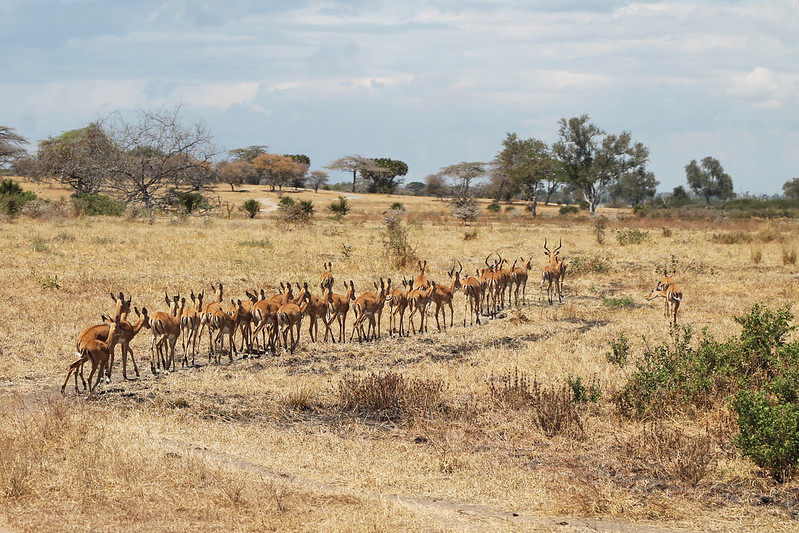
Beyond the water, Nyerere is still a full game-drive park, and a day here mixes a walking safari with time in the vehicle. The northern sector around the Rufiji holds good numbers of giraffe, impala, waterbuck, greater kudu, warthog and buffalo, with lion and the park’s famous wild dogs moving through when conditions suit them.
Wild dogs are the draw for a lot of returning safari-goers. Nyerere shelters one of the two strongest populations left in Africa, the other being Mana Pools in Zimbabwe, so your odds here are about as good as they get. Sightings still come down to luck and season, and no guide worth trusting will pretend otherwise, but this is a park where asking after the dogs is a reasonable thing to do.
A guided walking safari changes the register entirely. On foot, with an armed ranger, you read tracks, follow the small signs a vehicle rolls straight past, and get close to the detail of the bush. It is not about chasing big game on foot. It is about slowing everything down before you fly west to Ruaha.
Flying Between the Parks: The Nyerere to Ruaha Safari Connection
The link that makes this whole trip run is the scheduled light flight from Nyerere across to Ruaha. Reckon on about 90 minutes in the air, often with a short stop at an intermediate strip to pick up or drop other passengers, which is normal for these bush routes and nothing to worry about.
Carriers like Auric Air, Safari Air Link and Coastal Aviation run these southern routes, and camps handle the bookings as part of the package. Bring soft duffel bags rather than hard cases, since the aircraft are small and luggage allowances are strict, usually around 15 kilograms including hand luggage. The flight itself is half the fun, low over the miombo woodland and river systems, and you can often be on a game drive within an hour of landing at Ruaha.
Two flights and a handful of nights turn two very different wildernesses into one trip. Boats and hippos on the Rufiji, then lion prides in the Ruaha hills, with a woodland flyover in between.
Days Four and Five: Big Cat Game Drive Safari in Ruaha National Park
Ruaha is where the trip shifts gear into a proper big cat game drive safari. This is the second largest lion population on the planet, and the prides are unusually big, so morning and afternoon drives along the Great Ruaha River and its sand rivers give you a real shot at seeing them hunt, rest and move as a group. Leopard and cheetah are both present too, in healthy numbers rather than as rare one-offs.
Give Ruaha two full days of driving and the park opens up. The river is the spine of it in the dry months, drawing elephant, buffalo, zebra, giraffe and antelope down to the last water, with cats never far behind. Ruaha also carries the largest elephant herds in East Africa, and the mix of species is wide: greater kudu, the more unusual sable and roan antelope, and spotted hyena working the edges of every kill.
Morning game drive safari: Head out at first light when the cats are still active and the air is cool. This is prime time for lion and the wide-open predator sightings Ruaha is known for.
Afternoon and sundowner drive: Later drives run into the golden part of the day and often end with a drink out in the bush as the light goes. Elephants gather at the river through these hours.
Full day with a picnic: With two nights here you can commit a whole day to the more distant sectors, carrying lunch and staying out to reach areas the shorter drives never touch.
Day Six: Walking Safari and Elephant Herds on a Ruaha Adventure
Most Ruaha camps offer a walking safari, and it is one of the strongest reasons to give the park a third night. Ruaha’s terrain suits walking, all baobab-studded hills and dry riverbeds, and going on foot with an armed guide lets you learn the bush at a different scale: the dung, the tracks, the birds and the plants that a game drive skims past at speed.
You will not walk up on lions by design, and that is the point. A walking safari is slower and quieter, built around fieldcraft rather than a species checklist. Pair a morning walk with an afternoon drive and the day balances nicely, the walk for texture and the drive for the elephant herds and predators. Ruaha stays quiet even in peak season, so your walk rarely crosses paths with another group.
This is also the park for anyone who has done the northern circuit and wants something wilder. Where the Serengeti can feel busy at a good sighting, Ruaha often gives you a lion pride entirely to yourself. That solitude is the trade you make for the fly-in cost, and for a lot of people it is the whole reason they book the south.
Sample Six to Eight Day Ruaha and Nyerere Safari Itinerary
Here is how a comfortable Ruaha and Nyerere safari itinerary lays out across a week. Seven nights is the workable sweet spot, three in each park with travel days at either end. Trim it to six if you must, or stretch to eight for a slower pace and an extra walk.
Day 1: Fly from Dar es Salaam or Zanzibar into Nyerere National Park. Transfer to camp with a game drive along the way, then settle in for the first night beside the Rufiji.
Day 2: Morning game drive, then the headline late-afternoon Rufiji River boat safari for hippo, croc and riverine birds.
Day 3: Guided walking safari at dawn and a drive through the northern sector, keeping an eye out for wild dogs and lion.
Day 4: Bush flight across to Ruaha, roughly 90 minutes. Lunch at your lodge, then a first afternoon big cat game drive.
Day 5: Full day of Ruaha game drives along the Great Ruaha River, tracking lion prides and the big elephant herds.
Day 6: Morning walking safari followed by an afternoon drive into a quieter sector of the park.
Day 7: Final early game drive, then the flight back to Dar es Salaam or onward to Zanzibar for the beach.
Adding a Zanzibar Beach Extension to Your Southern Tanzania Safari
The southern circuit sets up beautifully for a beach finish, and a Zanzibar extension is the most popular way to close out the trip. There is a scheduled daily flight of about 60 minutes straight from Nyerere to Zanzibar, so you can roll off the last game drive and be on the sand the same afternoon. Plenty of people run it the other way too, doing the beach first and the safari second.
Four or five nights on Zanzibar is the usual add-on, enough to slow right down after the early starts of a safari. The island brings warm Indian Ocean water, the historic lanes of Stone Town, dhow sailing and diving over the reefs. A full trip of ten to twelve days, six or seven on safari and four or five on the coast, is about as complete a Tanzania holiday as you can build.
If you only have time for one southern park plus the beach, make it Nyerere. It is a single short flight from Zanzibar and delivers the boat safaris you cannot get anywhere else. Save Ruaha for a return trip when you have the full week.
Best Time for a Ruaha and Nyerere Safari
The dry season from June to October is the strongest window for both parks, and if game viewing is your priority, aim for it. As the bush thins and water dries up, animals cluster around the Rufiji in Nyerere and the Great Ruaha River in Ruaha, which makes the cats and elephants far easier to find. The heat is more manageable and the malaria risk drops as mosquito numbers fall.
June to October, dry season: The peak safari months. Best big game viewing, thinning bush, wildlife concentrated at the water. This is the window to book if you want the strongest lion and elephant sightings.
November to December, early green season: Rains are still light, the country greens up, and migrant birds arrive for excellent birding. Game viewing holds up well and camps are quieter.
January to February, calving and birding: A drier pocket within the green season, world-class for birds, with young animals being born. Boat safaris on the Rufiji are at their best here.
March to May, long rains: Heavy and often relentless from mid-March. Roads turn difficult, some airstrips flood, and a number of southern camps simply close. Best avoided for a first visit.
Bird watchers get their own calendar. The green months from November into February bring migrants and breeding plumage, and the Rufiji birding in that stretch is some of the finest in the country. If you can only travel then, Nyerere rewards you more than Ruaha for the wet-season conditions.
Getting There and Practical Planning for Your Southern Circuit Safari
International flights land at Julius Nyerere International Airport in Dar es Salaam, and most southern safaris start there or route through Zanzibar. From either point you connect onto the light-aircraft network into Nyerere. The parks themselves are not places you self-drive on a first trip, so almost everyone travels on a package where the camp arranges the internal flights, park fees and transfers.
Handpicked Nyerere safari packages
Tanzania requires a visa for most visitors, available online in advance or on arrival, plus a yellow fever certificate if you are arriving from a country where the disease is present. Southern Tanzania is a malaria area, so antimalarials and good repellent matter, especially around the water in Nyerere. Pack light and soft, in neutral colours, and remember the strict bush-flight luggage limits when you plan what to bring.
Because the south runs on fly-in access and smaller, more remote camps, it costs more per day than the northern circuit. What you buy with that is space. Boat safaris, walking safaris and lion prides you often have entirely to yourself, without the vehicle queues that build at a good northern sighting.
Frequently Asked Questions
How many days do I need for a Ruaha and Nyerere safari?
Plan for six to eight days on safari, not counting travel to and from Tanzania. Seven nights is the comfortable standard, giving three nights in each park plus the fly-in and fly-out days. Six nights works at a slightly faster pace, while eight lets you add an extra walking safari or a full day in Ruaha’s more distant sectors.
How much does a combined Ruaha and Nyerere safari cost?
Southern Tanzania is a fly-in region, so it sits above the northern circuit on price. As a rough guide, quality fly-in packages combining both parks often start from around 6,000 US dollars per person for a week, covering camps, park fees, internal flights and most meals. The internal bush flights run roughly 400 to 500 dollars per leg, and a private Rufiji boat safari sits around 50 to 200 dollars per person depending on group size. Budget road-based trips come in lower but cost you time on long drives.
What is the flight like between Nyerere and Ruaha?
It is a scheduled light-aircraft flight of about 90 minutes, often with a brief stop at another airstrip along the way. Carriers such as Auric Air, Safari Air Link and Coastal Aviation fly the route, and your camp arranges it. Luggage is limited to around 15 kilograms in soft bags because the planes are small, and you can usually be on a game drive within an hour of landing.
Can I add Zanzibar to the end of the safari?
Yes, and it is the most popular way to finish. A daily scheduled flight of about 60 minutes links Nyerere directly with Zanzibar, so you can move from your last game drive to the beach the same day. Most travellers add four or five nights on the island, and the whole trip usually lands around ten to twelve days.
Which park is better, Ruaha or Nyerere?
They do different things, which is exactly why the itinerary pairs them. Nyerere is the one for boat safaris on the Rufiji and for African wild dogs, and it is the easy add-on from Zanzibar. Ruaha is the one for big cats, huge elephant herds, walking safaris and genuine solitude. If you can only pick one and want the water, choose Nyerere. If you want lions and space, choose Ruaha.
When is the best time to book this safari?
The dry season from June to October gives the strongest game viewing, when wildlife gathers at the rivers and the bush thins out. November to February is quieter and superb for birding, with young animals around in the new year. Try to avoid the long rains from mid-March to May, when roads flood and some southern camps close for the season.